URL and Domain Architecture for Multi-Market iGaming Sites: Opening, Changing and Closing Markets
Last reviewed: October 2026
For a multi-market casino or betting site, URL structure isn’t just an SEO decision. It decides how easily you can open a market, change what you show in it, and leave it cleanly when the law changes. In 2026 alone, Finland opened licence applications ahead of a 2027 launch, New Zealand set a deadline for unlicensed online casinos, and India banned online money games and their advertising. An architecture that can’t absorb changes like those will eventually cost you rankings, or something worse.
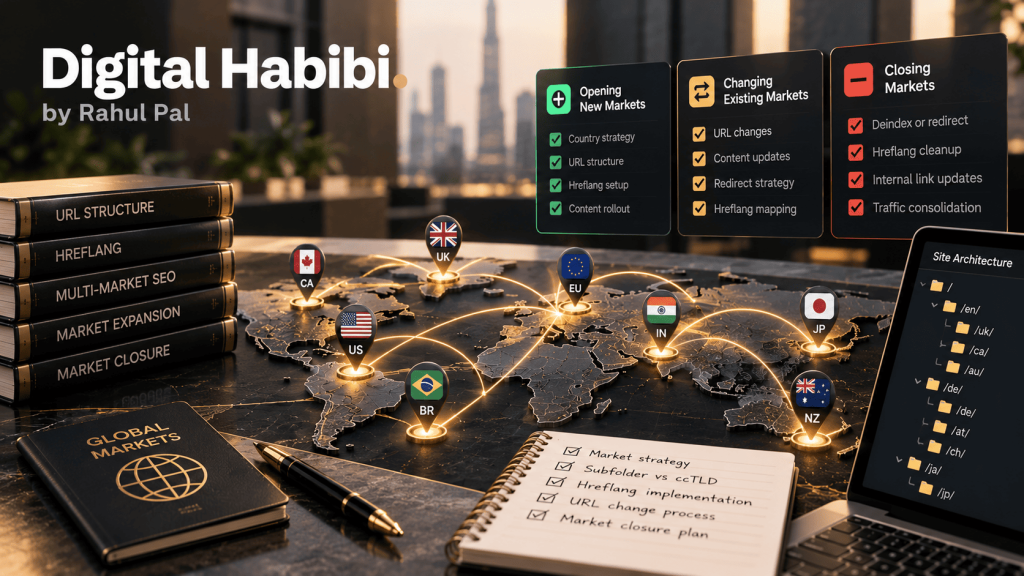
This guide covers how I’d structure a site that serves several regulated markets, and how to handle the three moments that test any structure: a market opening, a market changing its rules, and a market closing. It’s written for SEOs and site owners working only in markets where online gambling is licensed and legal.
The short answer
- For most affiliate sites, one strong domain with a subfolder per market is the best default:
/uk/,/ca-on/,/nz/. - Use a separate domain only for a real reason: a market that rewards a local domain, a separate business or brand, or a market you may need to leave without affecting the rest.
- Keep each market’s money pages, brand lists and compliance notes inside that market’s folder. Never mix markets on one money page.
- Use hreflang for country-level versions, but remember it can’t target states or provinces. Ontario and New Jersey need their own content, not just tags.
- Don’t redirect visitors by IP. Google crawls mostly from the US, so automatic redirects can hide whole markets from it.
- Plan for change: decide in advance what happens to a market’s URLs when it opens, when its rules change and when it closes.
The options, and what Google says about them
Google’s documentation on multi-regional sites sets out four ways to structure country versions. This is my summary of its pros and cons, with what each means for iGaming:
| Structure | Example | What Google notes | What it means for a casino site |
|---|---|---|---|
| Country domain (ccTLD) | example.co.nz | Clearest country signal; more cost and infrastructure; some countries restrict who can register | Strong local signal, but each domain builds authority alone. Worth it only where local trust or rules justify it |
| Subdomain | nz.example.com | Easy to set up; users may not know if “nz” means a language or a country | Rarely worth it. It splits signals without the clarity of a country domain |
| Subfolder | example.com/nz/ | Easy to set up and maintain on one host; geotarget less obvious to users | The best default. Every market benefits from the domain’s authority |
| URL parameter | example.com?loc=nz | Not recommended | Avoid |
Google also lists the signals it uses to work out a page’s target country: country domains, hreflang, local addresses, phone numbers, language and currency, and links from local sites. It ignores geo meta tags. For a subfolder structure, that means the content itself has to be clearly local: the right regulator, the right currency, the right payment methods and the right helpline.
The structure I’d use for a multi-market affiliate site
example.com/                     global home, market selector
example.com/guides/              market-neutral guides (how RTP works, odds explained)
example.com/uk/                  UK hub
example.com/uk/online-casinos/   UK comparison (UK-licensed brands only)
example.com/uk/reviews/brand/    UK review of a brand
example.com/ca-on/               Ontario hub
example.com/ca-on/online-casinos/
example.com/nz/                  New Zealand hub
example.com/news/                dated news, linked to the relevant market
A few rules make this structure work in practice:
- Every money page lives inside a market folder. A comparison or review without a market is a page you can’t keep compliant.
- Global guides stay neutral. They explain how things work and link to market hubs, but they don’t list brands or offers.
- The same brand gets a separate review per market. Licence, bonus, payment methods and terms are different in each one, so the page has to be too.
- Navigation is market-scoped. Someone on a UK page should only see UK brands and UK links in the menus and sidebars.
- Each market folder gets its own URL-prefix property in Search Console, so you can see performance by market at a glance.
hreflang: what it can and can’t do
hreflang tells Google which version of a page is meant for which language and country, so the right one shows in each market. On casino sites it’s also the thing that breaks most often, usually after a template change.
- Each version must list every other version, including itself, and the URLs must be indexable and canonical.
- Add an
x-defaultpointing to your global page or market selector. - Only pair pages that really are equivalents. A UK casino comparison and an Ontario casino comparison are equivalents. A UK review and an Ontario news story aren’t.
- Don’t add hreflang for a market where you don’t have a version. Leaving a market out is better than pointing it at the wrong page.
- For large sites, managing hreflang in XML sitemaps is easier to audit than tags in the page head.
The limitation people miss: hreflang works at the level of language and country. There’s no code for Ontario, New Jersey or any other state or province. If you serve several regulated states or provinces in one country, they share a country code, and Google has to tell them apart from the content: the regulator named, the licensed brands listed, local terms, links and internal structure. Make those differences obvious.
Don’t redirect by location
It’s tempting to send visitors to their own market automatically. Google advises against it. Its documentation says IP location analysis “is difficult and generally not reliable”, that most Google crawls originate from the US, and that automatic redirects can stop Google from finding all your versions. If a US-based Googlebot visiting /uk/ gets redirected elsewhere, your UK pages may never be crawled properly.
Instead, show a clear market selector and, where it helps, a non-blocking banner: “It looks like you’re in New Zealand. View our New Zealand pages.” Let people choose.
Some compliance setups do need to restrict access by location, for example to keep a market’s offers away from countries where they can’t legally be shown. If you have to do that, restrict the offer elements, such as bonus details and links, rather than the whole page, and test how Googlebot sees the page with URL Inspection. Blocking the entire page by IP can remove it from search altogether.
When a market opens
New regulated markets are the best opportunity in iGaming SEO, because the search results are still unsettled. The mistake is waiting for launch day. I’d plan it in three stages:
| Stage | What to publish | Why |
|---|---|---|
| Before applications open | An explainer on the new law: what changes, when, who can apply, what it means for players | Earns early links and rankings while competition is thin |
| During licensing | A tracker of licence applications and approvals, sourced to the regulator | Becomes the page journalists and AI tools cite |
| At launch | Comparison and review pages for licensed brands only, inside the market’s folder | The folder already has history, links and trust |
Finland is a good example. The National Police Board started accepting licence applications on 1 March 2026, and the licensed market opens on 1 July 2027. A site that starts its Finnish section now has more than a year of history by launch day.
Some markets also set rules on operator domains. In Brazil, operators offering fixed-odds betting must use a bet.br domain, under Ordinance No. 722/2024 and the registration rules issued in November 2024. That doesn’t change an affiliate’s own domain, but it does mean every link and brand mention for Brazil should point to the operator’s licensed bet.br site.
When a market’s rules change
Rule changes rarely need new URLs. They need fast, consistent edits across every page in the market folder, which is exactly why the folder structure matters. When Great Britain capped bonus wagering at ten times from 19 January 2026, every UK bonus page needed rewriting, and none of the Ontario or New Zealand pages did. With clean market folders, that’s a contained job. With mixed pages, it’s a site-wide risk.
- Keep a market sheet: legal status, regulator, licence register link, advertising rules and the date you last reviewed it.
- Use templates that pull market-specific notes, such as the helpline and age limit, from one setting per market.
- Re-check every listed brand against the regulator’s register after any rule change.
When a market closes
This is the moment that really tests an architecture. When online gambling or its advertising becomes illegal in a market, as happened with real-money gaming in India in 2026, the money pages have to go. How you remove them matters, for compliance and for the rest of the site.
- Remove brand listings, offers and affiliate links from that market’s pages straight away.
- Don’t redirect closed market pages to another market’s casino list. That’s still sending players from that country to gambling offers.
- Where the topic is still newsworthy, keep or create one explainer page on the new law with no brands, offers or links to operators.
- Return a 410 for money pages that no longer have a purpose, or redirect them to that explainer. Both are cleaner than leaving thin pages up.
- Remove the market from your hreflang clusters and sitemaps, and from the market selector.
- Keep a record of what you removed and when, in case you’re ever asked.
A separate domain makes this cleaner, which is the one strong argument for it. If you’re entering a market where the rules look likely to change, a standalone site can be closed or repurposed without touching your main domain. The trade-off is that it has to build its authority from scratch.
A checklist before you add a market
- Online gambling is licensed and legal there, and you know which products are covered.
- You know the advertising and affiliate rules, including any requirement to check licences.
- The market has its own folder, hub page and Search Console property.
- Every brand you plan to list holds a licence in that market, with the register link recorded.
- hreflang clusters include the new market only where there are true equivalents.
- No IP redirects; a selector and banner instead.
- You’ve decided what happens to the folder if the market closes.
Frequently asked questions
Are subfolders or country domains better for iGaming SEO?
For most affiliate sites, subfolders on one strong domain are better, because every market benefits from the domain’s authority. Country domains make sense where local trust or regulation justifies the extra cost, or where you may need to separate a market completely.
Can hreflang target US states or Canadian provinces?
No. hreflang uses language and country codes only. Pages for different states or provinces in the same country need clearly different content so Google can tell them apart.
Should I redirect visitors to their country’s pages automatically?
No. Google advises against IP-based redirects because they’re unreliable and can stop Googlebot, which mostly crawls from the US, from reaching your other versions. Use a market selector or a banner.
What should I do with pages for a market that bans online gambling?
Remove brand listings, offers and affiliate links immediately. Don’t redirect those pages to another market’s casino list. Return a 410 or point them to a neutral explainer on the new law.
When should I start content for a newly regulating market?
As early as the law is clear. An explainer and a licence tracker before launch build history and links, so your comparison pages start from a stronger position on launch day.
Final word
Good architecture for a multi-market casino site is mostly about containment. Each market lives in its own space, with its own brands, rules and notes, so a change in one never spills into another. Set that up once and opening, updating or closing a market becomes routine work instead of a crisis.
If you’re planning a multi-market structure or untangling an existing one, get in touch. For the year’s regulatory changes, see iGaming SEO trends 2026.
I work only with brands licensed in the markets they serve, in markets where online gambling is legal. This guide is for SEO professionals and site owners, not players, and it isn’t legal advice.
Sources
- Google Search Central: Managing multi-regional and multilingual sites
- Google Search Central: Tell Google about localized versions of your page (hreflang)
- SOFTSWISS: Regulatory trends 2026, first half-year recap
- Yogonet: Finland grants new operator licence ahead of market opening (October 2026)
- Mattos Filho: Brazil regulates bet.br domain registration for betting operators
- UK Gambling Commission: Gambling promotions to be safer and simpler